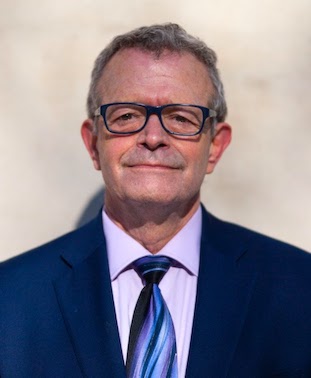
Rev. Dr. Larry A. Golemon, Ph.D.
Dr. Golemon served as the Executive Director of the Washington Theological Consortium for 15 years, from 2011-2026.
His priorities for the Consortium were strengthening working relations between leaders in member schools; building collaboration between schools and associate and affiliate members; developing unique public, faculty, and student programs about religion in public life; building new collegial relationships between different faculties; and developing relationships between students on different campuses.
He helped integrate innovations at individual member institutions–like online learning and virtual leadership consultation – into the practices of the Consortium. Larry built up Consortium membership through the inclusion of an Eastern Catholic seminary, an ecumenical organization committed to East-West Church relations, and an educational museum in Washington, D.C. He also works to develop collaborative programs with outside organizations, especially in interfaith education and leadership.
One of his signature accomplishments has been to take the learnings from earlier interfaith courses to develop a full blown Abrahamic Dialogue immersion course with students from Christian, Jewish, and Muslim seminaries. In addition he has worked closely with faculty to expand the Certificates of Study in the Consortium beyond those in Ecumenism and Muslim-Christian studies to include Ecology and Theology, Criminal Justice and Reconciliation, and Ecumenical Spirituality.
Larry has served the wider church in a variety of capacities: youth minister, local pastor, college and seminary professor, missionary, and researcher. He received a B.A. in History from Stanford University, a Master of Divinity and a Master of Sacred Theology from the Yale Divinity School, a ThM from Columbia Theological Seminary, and a PhD in contemporary theology from Emory University’s Graduate Division of Religion. He is an ordained Presbyterian minister (PCUSA).
As a researcher, Dr. Golemon was an associate for the national study of theological education by the Carnegie Foundation for the Advancement of Teaching, and co-authored their findings in Educating Clergy (2006). He taught at Dominican University of California and the Graduate Theological Union, and directed their research project entitled “Sacred Visions and the Social Good,” which explored religion in public life among Buddhists, Sufis, Native Americans, and faith-based Catholic and Protestant parishes. While at the Alban Institute in Virginia, he directed the Narrative Leadership project, which explored story-based transformation of congregational life. He also coordinated the “Ecumenical Project” at Virginia Theological Seminary, which identified capacities and new possibilities for ecumenical teaching and learning.
He continued a focus on theological education, with a 2021 book entitled Clergy Education in America: Religious Leadership and American Public Life, 1785-1935 (Oxford Press). The book analyzes how Protestants, Catholics, and Jews have educated clergy for American society, specifically as culture-builders in religious and public life. Later schools for woman, African Americans, and the white working class followed suit in their own distinctive ways. It is an historical argument for developing clergy today as cultural creators and thought leaders in society as well as the church. Listen to a 2025 interview with Dr. Golemon on Close Up Radio podcast.
Selected Writings of Rev. Dr. Larry Golemon
Clergy Education in America: Religious Leadership and American Public Life: 1785-1935 (Oxford University Press, 2021).
“Professional Identity Formation Throughout the Curriculum: Lessons from Clergy Education” in Mercer Law Review, 68:3, Spring 2017, 649-663.
Finding our Story; Teaching our Story; Living our Story. Herndon, VA: Alban Institute Narrative Leadership Series. 2009. Editor and contributor to three volumes on Narrative Leadership project at Alban. Focus on relating narrative theory and practice from education, psychology, theology, business, and therapy contexts to revitalizing congregational life and theological studies.
Spotlight on Theological Education, American Academy of Religion: March 2007, March 2008. Editor and contributor to the first two issues of this journal, focusing on best practices in theological and rabbinic education in Protestant, Catholic, and Jewish schools.
“Practices of Integration in Clergy Education,” Reflective Practice: Formation and Supervision in Ministry, Herbert Anderson, ed., vol. 27, 2007, 136-149.
with Ellen Hammerle, Arthur Scott, D. Mark Wilson, and Colleen Hicks, “Sacred Visions and the Social Good: An Interfaith Approach to Religion in Public Life.: Online article for Sacred Visions Project, Dominican University. (2006).
Charles Foster, Lisa Dahill, Lawrence Golemon, and Barbara Wang Tolentino. Educating Clergy: Teaching Practice and the Pastoral Imagination. San Francisco: Jossey Bass, 2006. Co-author of this Carnegie Study of Protestant, Catholic, and Jewish clergy education in the U.S., based on four year ethnographic and historical research.
“Teaching What May Not Be Practiced: A Review of Teaching Theology and Religion” in Teaching Theology and Religion, 5:4, October 2002, 236-242.
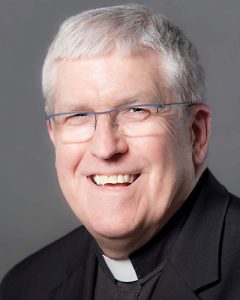 Rev. John Crossin, OSFS, Ph.D. (+2023)
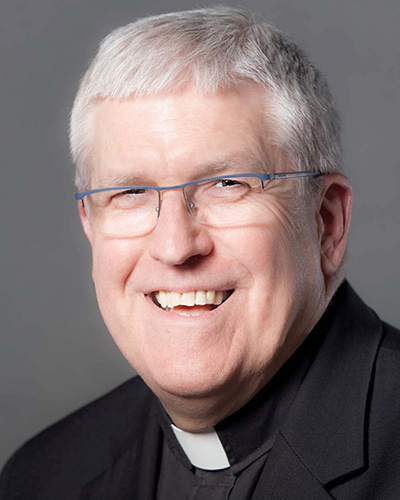
The late Fr. Crossin served as Executive Director from 1998-2011.
As Executive Director of the Washington Theological Consortium, Fr. Crossin worked with Catholic, mainline Protestant, Evangelical, and Historic Black Divinity schools to strengthen the institutional bonds of the Consortium schools, and he brought in the first Islamic Studies school in the U.S. as a member. He also strengthened the initial Certificate in Ecumenism awarded by the Consortium and helped to develop the Certificate in Muslim-Christian Studies.
He was honored with the WTC Ecumenism Award in 2021, when he also gave the Consortium’s Figel Address on Ecumenical Dialogue, and he was memorialized at an academic symposium in 2024, a year after his death.
Fr. Crossin was a member of the Oblates of St. Francis de Sales, was a moral theologian and ecumenical scholar. He had a long career in ecumenism and interreligious dialogue, having served as the Executive Director of the Secretariat for Ecumenical and Interreligious Affairs of the United States Conference of Catholic Bishops, where he staffed numerous bi-lateral and interfaith dialogues and developed new resources for ecumenical and interfaith education.
He also served as a visiting fellow with the Woodstock Theological Center at Georgetown University, and taught in numerous schools in the Consortium, including Wesley Theological Seminary, the Catholic University of America, Virginia Theological Seminary and Gettysburg Lutheran Theological Seminary. He also taught and served as Academic Dean and President of the DeSales School of Theology in Washington, D.C. He was past President of the North American Academy of Ecumenists, Consultor to the Pontifical Council for Promoting Christian Unity (2014-2020), and was a member of the Pontifical Council’s team for the Joint Working Group with the World Council of Churches. He also served on the spirituality team of Saint Luke Institute, a mental health center for Catholic clergy and religious sisters and brothers in Silver Spring, Maryland. He was a a board member of the Interfaith Conference of Metropolitan Washington. Fr. Crossin authored numerous articles on moral theology and ecumenism and several books, including Everyday Virtues (Paulist Press), and the final book published months before his death, Moving into the Ecumenical Future: Foundations of a Paradigm for Christian Ethics.